
Last updated: November 2026
TL;DR: To choose a floor lamp, decide its job first (filling the room with light, reading, or a sculptural accent), then check height, base size and the direction of the light. Most floor lamps stand between about 58 and 68 inches; when you sit beside one, the light source should sit at or just above eye level. In a room with no ceiling light, a floor-to-ceiling lamp or two floor lamps at different heights can light the whole space.
1. Start with the job
- Room-filling light: frosted or milky glass that sends light in every direction.
- Reading light: a light you can aim, placed beside or slightly behind your seat.
- Corner glow: a softer lamp that lights a dark corner and the walls around it.
- Sculpture: a lamp that shapes the room even when it's switched off.
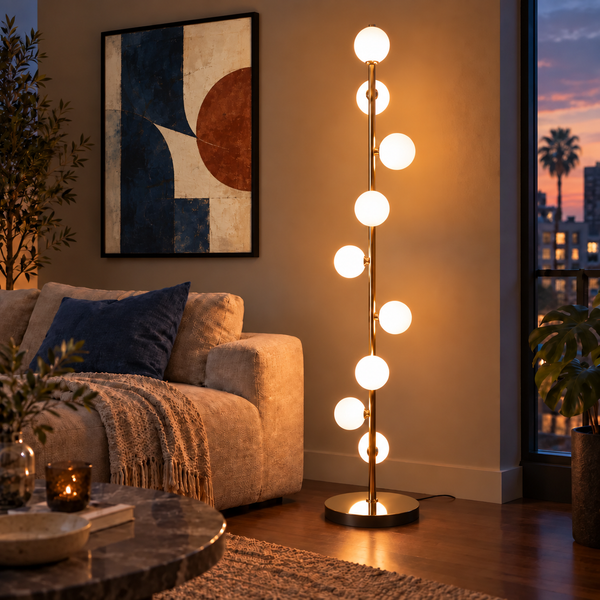
For room-filling light, Pearl sends soft light through nine milky glass globes and dims with a knob. For light you can aim, Caviar has six domes that each turn 360°, so you can point its warm glow at your chair, a wall or the room.
2. Check the height
Most floor lamps fall between about 58 and 68 inches. When you're seated next to the lamp, the light source or the bottom of the shade should sit at or just above eye level, so you see the light, not the bulb.
Proportion matters too: a slim lamp can disappear in a tall room with large furniture, and a big sculptural lamp can crowd a small one.
| Lamp | Height | Type |
|---|---|---|
| Pagoda | 48 in | Stacked tiers, smart bulb |
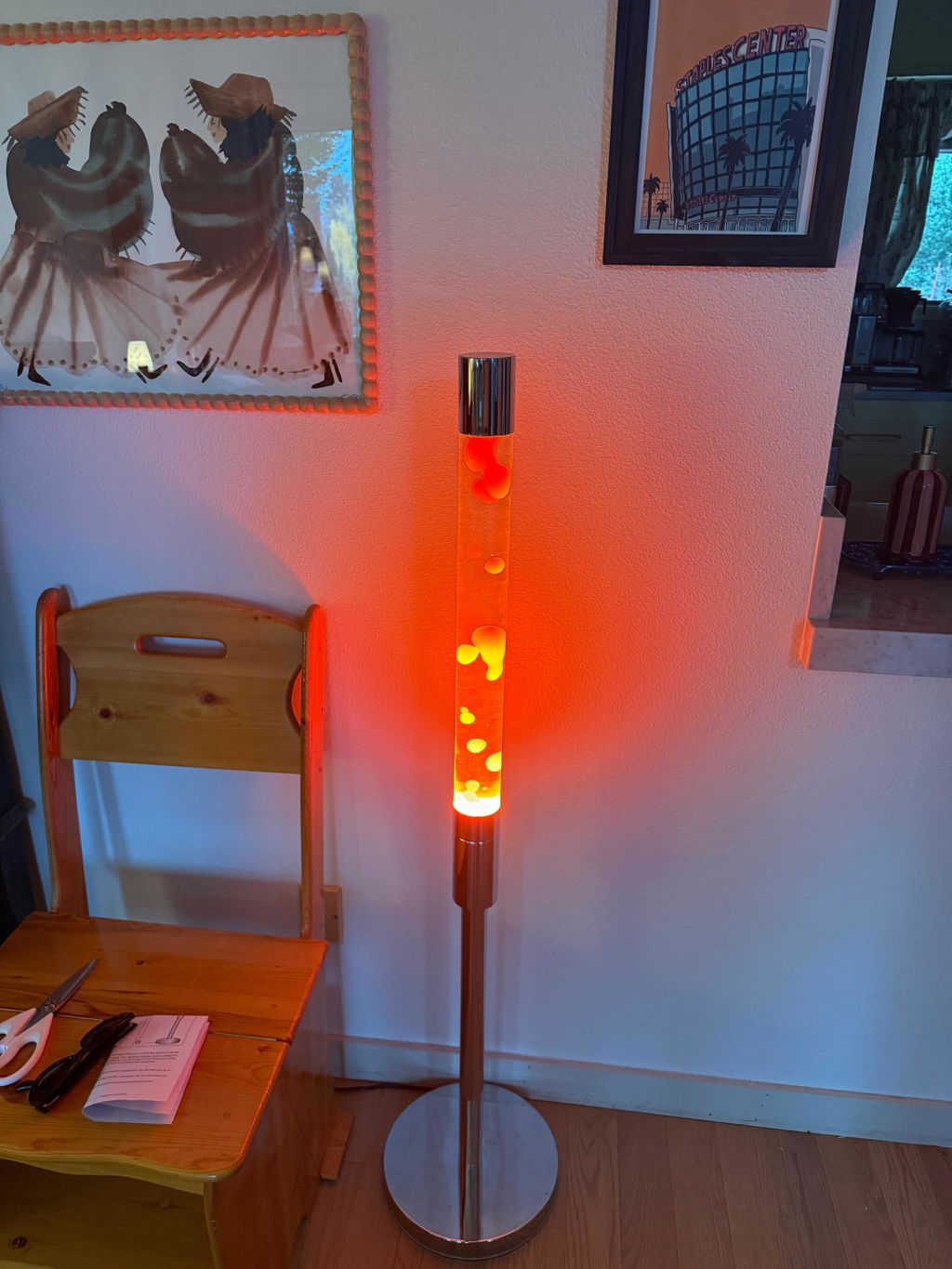
| Molten | 49.2 in | Lava floor lamp |
| Caviar | 56.7 in | Six turning chrome domes |
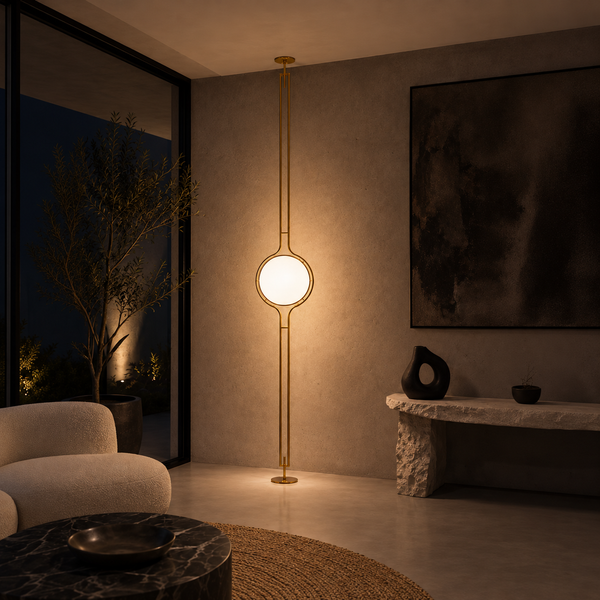
| Aperol | About 59 in | Ringed dome, smart bulb |
| Pearl | 61 in | Nine glass globes |
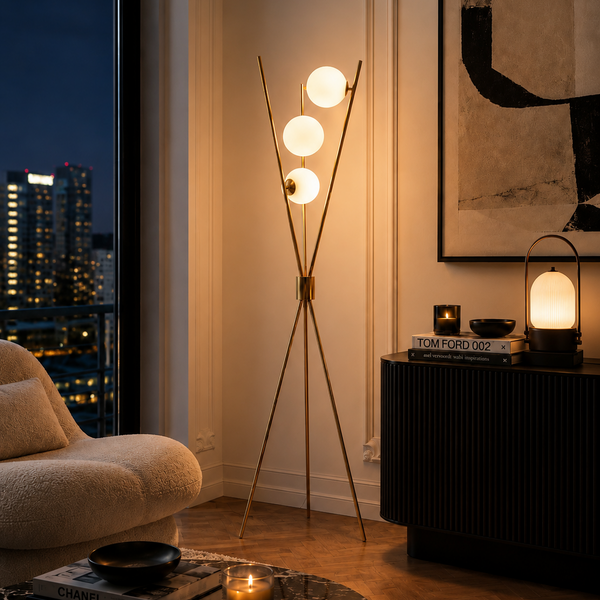
| Triglobe | 64 in | Three glass globes on a tripod |
| Saturn | 65 in | Chrome dome, smart bulb |
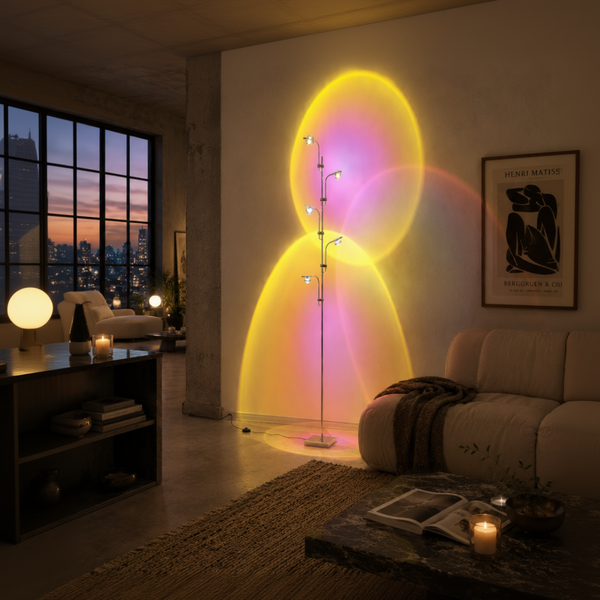
| Polynescence | 71.5 in | Five chrome light arms |
| Pluto | Floor to ceiling, 97.5 to 110 in | Glowing orb, tension-mounted, smart bulb |
| Vector | Floor to ceiling, 102 to 138 in | Three light cones, one screw at the ceiling |
3. Check the base
- Round bases tuck into corners and beside sofas. Pagoda and Molten stand on bases about 10 to 11 inches wide.
- Tripod bases are steady and look architectural, but take more floor space. Triglobe stands on a matte nickel tripod.
- Floor-to-ceiling lamps take almost no floor space, because the ceiling holds them in place.
4. Choose the direction of the light
- Upward light bounces off the ceiling for soft, even light. Good for atmosphere, less good for reading.
- Downward light lands on one spot. Good for tasks, but harsh on its own.
- All-around light from glass globes or multiple arms gives the most even glow. Polynescence sends light from five chrome arms, and comes with 25 color filter films.
5. Rooms with no ceiling light
Many living rooms and bedrooms, especially in rentals, have no ceiling fixture. Here a floor lamp is the main light, not an accent. Use two lamps in different parts of the room, or a floor-to-ceiling lamp. Pluto holds a glowing orb between floor and ceiling by tension, with no drilling, and plugs into an outlet. More in our guide to lighting a room without overhead lights and our floor-to-ceiling lamps guide.
6. Match the style
- Finish: gold and brass warm up wood and textiles. Chrome, black and nickel suit cooler, more minimal rooms. Mixing two metals often looks more considered than matching everything.
- Shape: rounded, organic shapes feel soft. Geometric shapes feel modern and deliberate.
- Fit: echo a metal or color that's already in the room, or contrast it on purpose.
7. Consider a smart floor lamp
Pluto, Pagoda, Aperol and Saturn come with the La Caza Smart Bulb. It works with Apple Home, Siri and the free La Caza Cali App, which can warm and dim the light through the day. See beautiful smart lamps.
8. Place it well
- Beside or slightly behind a seat, not in front of it.
- Near a light wall or a mirror, so the light bounces back into the room.
- In large or open rooms, use two lamps in different zones.
Our floor lamp placement guide goes room by room.
Quick checklist
- What is the lamp's job?
- Does the height suit the seat or the room?
- Does the base fit the spot?
- Which way does the light go?
- Does the finish suit the room?
- Do you want to dim it, or control it from your phone?
FAQ
How tall should a floor lamp be?
Most are between about 58 and 68 inches. Beside a seat, the light source should sit at or just above eye level when you're sitting down.
What kind of floor lamp gives the most light?
Lamps with several glass globes or arms that send light in every direction, like Pearl, Triglobe or Polynescence. For a room with no ceiling light, a floor-to-ceiling lamp like Pluto lights the room from top to bottom.
Where should a floor lamp go in a living room?
Beside or slightly behind the sofa or a chair, or in a dark corner. Our placement guide shows options for each room.
Can a floor lamp replace a ceiling light?
Yes. Use two floor lamps in different parts of the room, or a floor-to-ceiling lamp, which plugs into an outlet and lights the room like a ceiling light.
Need help choosing?
Text us a photo of your room at 949-527-0866 or email info@lacazacali.com, and we'll suggest a lamp.